How we built Akua's data platform: one layer at a time
How we serve accurate, isolated, and fresh data to every bank, client, and merchant operating on Akua, and why no piece of our architecture is definitive.

A card payment leaves a trail in several services before it is closed. Authorization lives in the online service. Network submission lives in clearing. Visa or Mastercard confirmation arrives in network files. Fees, taxes, and withholdings are calculated in the tax and withholding engine, which also defines the settlement to the merchant. The complete picture of that transaction is assembled between the day of purchase and the following 24 hours.
This fragmentation is no accident. Akua was conceived from day one as a platform to scale regionally, with each domain as an independent service and owner of its data. Our business model adds two more dimensions: banks and processors operate on Akua as tenants, each with their clients and merchants, and they do so in several countries, each with its taxes and formats.
The same transaction must reach every actor who touched it, completely. And only them.
From this, three non-negotiable requirements emerge:
- Accuracy. Reconciliation is money. A cent's difference between what the network confirmed and what we report is a client problem, not a technical detail.
- Isolation. Each tenant, each client, and each merchant sees their data and nothing else.
- Freshness. Operations needs to know in minutes, not the next day, that an issuer stopped approving.
There isn't one tool that solves all three at once. What does work is a modular architecture, which generates value from day one and grows at the pace of operations.
In this post, we follow that same payment end-to-end. In each segment, we discuss what problem arises, how we solved it, and what we learned.
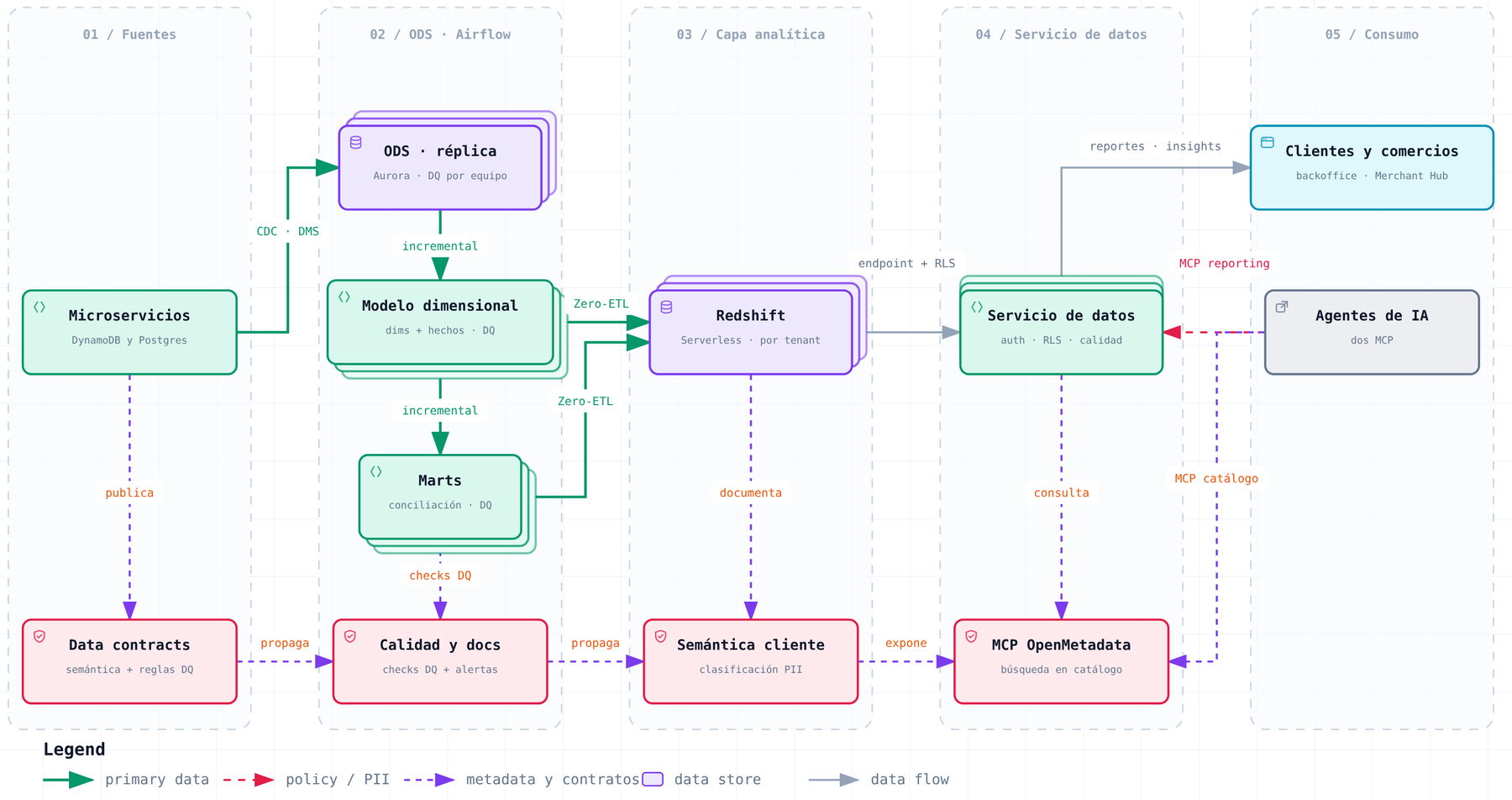 End-to-end data pipeline
Data connects when the service is born
The initial payment is born distributed across several microservices, each with its own database.
In many platforms, adding a new source is a request to the data team that waits its turn. Each hand-written extractor is a debt someone has to maintain.
At Akua, we approached it as follows: ingestion is an engineering platform capability. With the Internal Developer Portal, which Luispe Toloy discussed on this blog, a team launches a microservice and decides in the same step if its data is replicated. Everything is infrastructure as code and works the same with DynamoDB or PostgreSQL.
Thus, each part of the data that makes up a payment arrives almost in real time at a single location, without anyone writing a line of integration.
A single model for all tenants
Once together, the pieces of the payment must fit into a common shape.
The first destination is the Operational Data Store (ODS), an Aurora PostgreSQL per tenant. Here, the raw data from each service coexists, where engineering teams can also consult it in read replicas without touching production.
On top of the ODS, we built a dimensional model orchestrated by Airflow. The world of payments responds to a star-shaped model: how much, how many times, approved or rejected, by merchant, issuer, network, and date.
- Dimensions: merchants, clients, instruments, and BINs. Each change adds a new version and never overwrites the previous one.
- Facts: transactions, payments with their lifecycle, fraud evaluations, and clearing.
- Marts: tables for business use, such as financial reconciliation, which unites the payment cycle in a single row.
Here, the first requirement, accuracy, comes into play. Each fact points to the version of the merchant active when the payment occurred: a March report shows the March configuration. Reprocessing does not change history.
Each tenant can be on a different platform version, but all share the same model. This was the decision that paid off the most for us: what is built on top serves a new tenant from day one.
A new bank does not bring a new model: it brings data to the same model.
Data trustworthiness is designed
As the payment progresses, everything that explains it travels in parallel.
Accurate data that no one understands is useless for decision-making. That's why each segment of the journey has its metadata counterpart, managed in OpenMetadata as code:
- Data contracts: each service publishes the semantics of its columns and its quality rules. Whoever generates the data documents it.
- Quality and docs: quality checks run on the model and marts, and alerts are sent to Slack.
Semantic per client: in the analytical layer, each column inherits its description and sensitive data classification.
- Catalog and lineage: everything ends up in a catalog with column-level lineage. Anyone can see where a data point comes from without asking who wrote the ETL.
The catalog states what the data is, not what someone remembers it was.
Each layer enters when the business demands it, not before
For a while, payments were consulted in the same ODS where they were transformed.
To begin with, it was the right option: a single place and zero integration. The analytical layer came into play when two signals coincided:
- Performance: as volume grew, analytical dashboards began to overload the ODS: a transactional engine is not designed to aggregate long periods.
- Isolation: we want clients to also access their data. This requires a physical boundary that guarantees security, scalability, and isolation.
Today, the model arrives via Zero-ETL to a Redshift Serverless per tenant, with no loading pipeline to maintain. Isolation has two levels:
- By tenant: each bank or processor has its own Redshift. Their queries never compete with those of another, and compute is not paid for when not in use.
- By client: each client has their own database, only with their data, with row-level security (RLS) by organization, merchant, etc.
We didn't start with this layer, and we didn't need to. Adding it didn't force us to rewrite anything that came before.
A single door for all data
The last segment is for the payment to reach who needs it, and only them.
Internal teams, clients, merchants, and agents ask for data all the time. An architecture that supports this, with each one entering through their own side, is what allows data access to be democratized. That's why we built our own data service, deployed per tenant, as the single entry point.
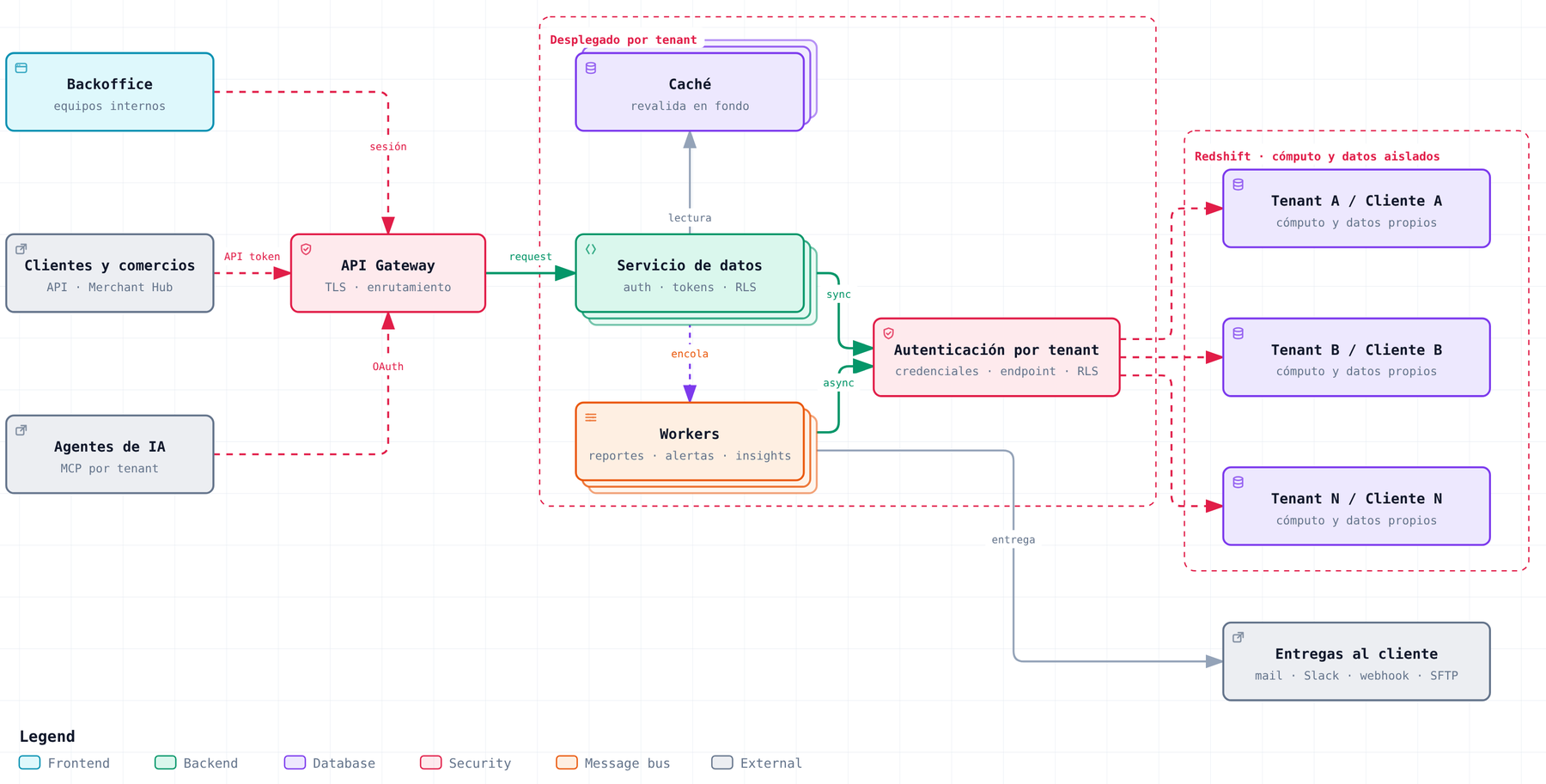
- Authentication by tenant: each query travels with authentication that identifies which tenant, client, or merchant it represents and how far they can see.
- API Gateway: receives each request with authentication, whether from the backoffice, a client, or an agent, and routes it.
- Data service: receives who is asking and their credentials, validates, and internally redirects requests.
- Cache and workers: the cache responds instantly and is revalidated in the background. Workers generate reports, alerts, and insights and deliver them by email, Slack, webhook, or SFTP.
In the last month, this service handled nearly 1 million requests and executed over 1.7 million background tasks. A report here is configuration, not code: a template, a variant per country, and an instance per client. And each file passes quality checks before being delivered to a client's SFTP.
The final consumer of payment data doesn't have to be a person
Being AI-native doesn't mean giving a model access to the database. It means that AI is just another consumer of the same service, with the same isolation. That's why we connected two MCPs that work together:
- Reporting MCP: exposes the data service. An agent, or a person from their assistant, lists, creates, and executes reports with the same rules as the API.
- OpenMetadata MCP: exposes the catalog: what each column means, where it comes from, and what data is sensitive. This gives the agent the business context.
This is how the flow works:
someone writes
«I need last week's rejections by issuer, with net fee».
The agent first consults the catalog to understand each concept and which columns answer it.
Then they build the report and execute it through the Reporting MCP, within the limits of who requested it.
This flow already lives inside Cowork, Akua's dashboard agent. Cowork is connected to the MCPs of various services and operates its APIs autonomously, always with the permissions of the authenticated user. The client identifier is injected from the session and the agent has its own identity: Santiago Barclay explains how we ensure this in How we securely implemented AI at Akua.
Data that generates value from day one
Returning to the payment from the beginning: its data originates in several services, each with an owner who knows it better than anyone. Our architecture brings it into a common form without asking that owner to change anything.
That's the real change: abstracting the relational model of each service into the model the business needs to operate. Without design barriers or fragmentation, the compute and data of each client remain isolated and ready to be delivered to them.
A report answers a question someone has already asked. Modeled data, in dashboards, alerts, and agents that interpret them, does something more valuable: it generates new questions. And those questions are what allow an operation to be understood and scaled without scaling the team.
That's why we design data to generate value from day one, not after a two-year project. A new tenant arrives with its model and catalog functioning, and a new agent arrives with the same permissions as the person using it.
In payments, every point of approval and every day of reconciliation translates into money. An operation that asks its data, and to which AI responds with context, has an advantage that cannot be bought with a tool.
PostgreSQL, Redshift, Zero-ETL, or OpenMetadata are stage decisions. What doesn't change are the contracts between layers: a unique model, isolation by design, and verified quality before each delivery.
For anyone designing the data architecture of a payment platform, these are the three principles that yielded the most for us:
- Model before scaling. A common model from the first tenant is worth more than any analytical engine. Everything else is built on that shape.
- Isolate by design. Isolation by tenant, client, and merchant must live in the architecture, not in the filter of each query. This applies equally to people and agents.
- Activate layers by business signals. Each component enters when a concrete signal (performance or isolation) justifies it. Not before.
And this is not the final version either. The next layer already has its place in the plan and will enter when the business demands it, without the data consumer noticing the change.
The best data architecture is not the one with the best pieces. It's the one that generates value from day one and can change a piece without anyone noticing.

Webinar · Ver grabación
AI Data-Driven: así se ve una operación inteligente
Lautaro Olivares y Carol Malez Ruiz
Ver webinar