Inside Google Pay: The Akua Team That Made It Happen
Luciano Barrera, Javier Perez, and Nicolas Carrascosa, product specialists at Akua, share how they built Google Pay™ on top of our infrastructure: what they solved, the decisions they made, and what changes for anyone managing payments at a bank or fintech.
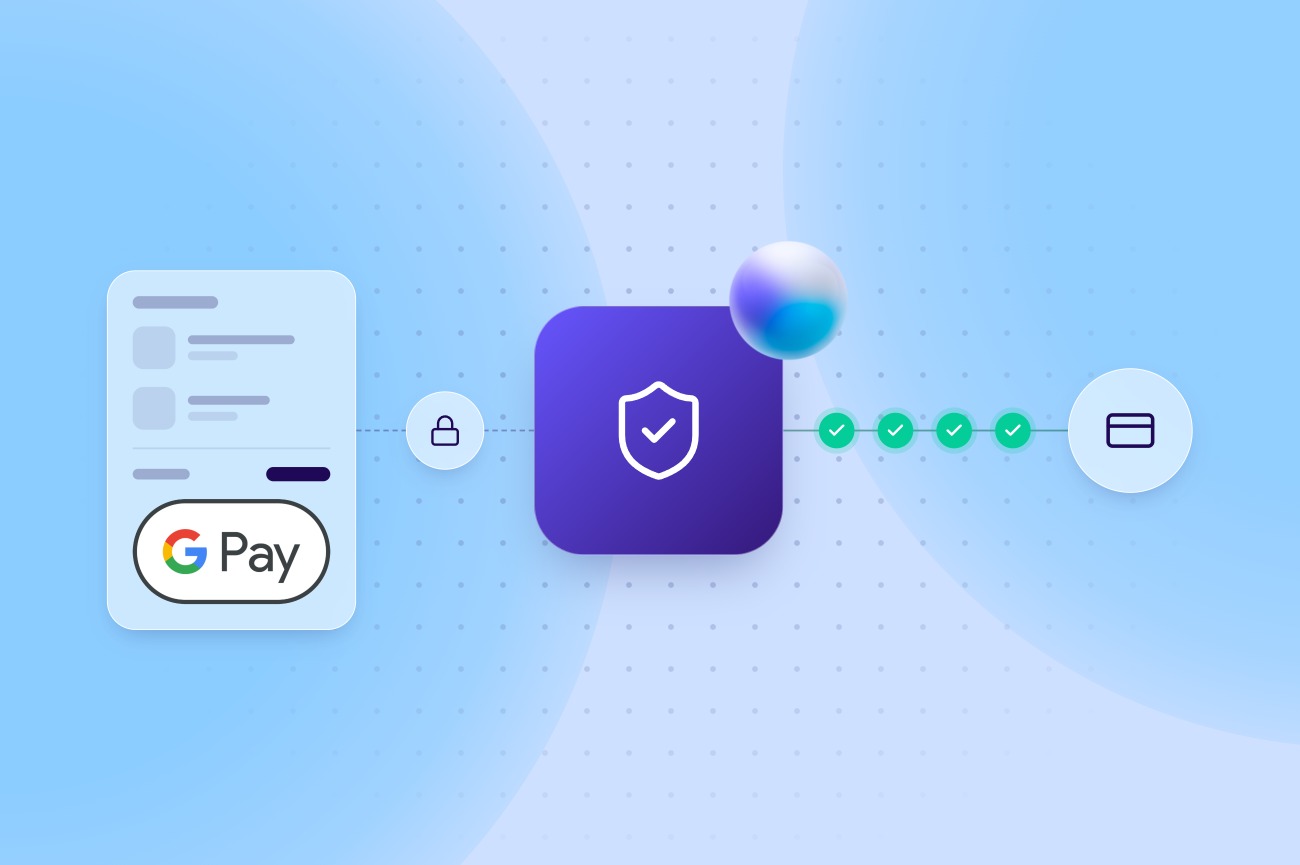
If you manage payments for a bank or fintech, you know that moment all too well: a buyer manually typing out their sixteen card digits, expiration date, and security code—every single field is an opportunity for error and, with it, a payment that might never go through.
That was the project’s starting point. Our clients were looking for a faster way to accept payments, with fewer steps and less friction, driven by one clear objective: increasing the number of successful payments. Google Pay solves precisely that, because the card is already stored in the buyer’s Google account or on their device, turning checkout into a single tap.
“We know that manually entering card details is extremely error-prone. When the card is already saved in a secure place like Google Pay, that step simply disappears.”

— Nicolas Carrascosa, Payments Specialist at Akua
Behind that button worked three product specialists. Luciano Barrera, Backend Product Engineer on the Processor team, was responsible for receiving, verifying, and decrypting every payment. Javier Perez, Tech Lead on the Experience team, built the checkout button and structured the request sent to the processor.
Nicolas Carrascosa, Payments Specialist, coordinated the relationship with Google and client enablement. In this article, each of them shares their part of the project.
01 · Processor, with Luciano Barrera
What happens when someone taps the button
Akua processes Google Pay as a registered gateway with Google. This means Google encrypts card details so that only Akua can decrypt them. The merchant, via our client’s platform, receives this encrypted token and forwards it to us untouched—meaning they never see card data or manage keys.
“When someone pays with Google Pay, we don't receive the card: we get an encrypted payload that only Akua can open. First, we verify that it was generated by Google, that it is addressed to us, and that it hasn't expired. Only then do we decrypt it, send the payment to Visa or Mastercard, and the issuing bank decides whether to approve it.”

— Luciano Barrera, Backend Product Engineer, Processor team
Luciano has been on the Processor team—the engine orchestrating every payment at Akua—for just over a year. When a transaction comes in, it coordinates validations across Fraud, Merchants, and Cards teams, routes the payment to the card networks through our rails, and once the response arrives, continues managing it throughout its entire lifecycle: captures, voids, refunds, and reconciliation.
Here is what a Google Pay token looks like from the outside when it arrives at Akua:
// Google Pay token (ECv2 protocol), viewed from the outside{ "protocolVersion": "ECv2", "signature": "MEUCIQ…", "intermediateSigningKey": { "signedKey": "…", "signatures": ["…"] }, "signedMessage": "{\"encryptedMessage\":\"…\",\"ephemeralPublicKey\":\"…\",\"tag\":\"…\"}" }
Akua supports both methods offered by Google Pay: the card saved in the Google Account and the device token, which includes a one-time cryptogram for each purchase. It works with Visa and Mastercard, with real payments already approved on both networks.
02 · Processor · Security
Four checks before reading a single data point
Before decrypting a payment, Akua answers four questions, always in the same order. If any of them fails, the payment is rejected and the token remains unopened.
- Was it signed by Google? We verify the signature chain against Google’s public keys.
- Is it addressed to Akua? The recipient is signed within the token and must match gateway:akua.
- Did it arrive intact and is it still valid? We confirm that no one tampered with it in transit and that it has not expired.
- Decrypt. Only when all three preceding conditions are met is the token decrypted using Akua’s private key.
Once decrypted, the payment follows the exact same path as any other card on Akua: the same validations, the same fraud checks, and the same direct connection to Visa and Mastercard. Google Pay processing leverages our existing infrastructure.
03 · Processor · The technical challenge
Implementing ECv2 in Go, without an official library
Google secures every payment with a protocol called ECv2, which combines digital signatures and elliptic-curve cryptography. To implement it, Google provides its reference library, Tink, but only in Java. Our platform is built in Go, and Google offers no official library for Go.
We decided to implement ECv2 ourselves in Go, adhering strictly to Google’s specification and using only the language's standard cryptography, without third-party libraries. Writing custom cryptography demands rigorous testing, so we validated it across three layers.
Google as the benchmark
We built a program using Google's official Java library to generate authentic tokens, and our Go code decrypted them just as Google would. We also ran the reverse test: Google’s library successfully accepted tokens generated by our code.
Our own payment generator
We created a tool that generates encrypted Google Pay payments on demand. With it, we tested the end-to-end flow independently of third parties and intentionally simulated altered, expired, and revoked-key tokens. In every case, Akua rejected them.
Real data from Google
We validated against tokens from Google's test environment as well as production tokens provided by Google for this purpose. Then came the first live, approved payments.
“Since there was no official library for our language, we implemented it ourselves and validated it against Google’s official library, with AI accelerating the entire process.”
— Luciano Barrera, Backend Product Engineer, Processor team
04 · AI in the engine
What AI brought to the table and what the team decided
Across the Processor team, AI worked side by side with Luciano and his teammates throughout the project, tackling specific tasks that accelerated development and validation:
- It parsed Google's specification and translated it into an actionable implementation guide.
- It allowed us to work in Java—a language the team doesn't typically use—to build the validation program using Google's library.
- It wrote testing tools alongside the codebase, including the payment generator and error test cases.
- It helped spot edge cases prior to launch. Google does not send the card security code (CVV), but our internal rules initially required it; we caught this during testing and resolved it before going to production.
Core architectural decisions always remained with the team: security posture, key custody, Google registration, and code review for every change.
05 · Processor · Built for production
Decisions engineered to operate at scale
The key used to decrypt Google Pay transactions is generated and stored encrypted within a dedicated key-custody service, and only the decryption service is authorized to request it. Around that foundation, we established several decisions ensuring seamless operation across all our clients.
- Zero-downtime key rotation. When a token arrives, Akua checks the active key first, then falls back to the previous one. This allows us to rotate keys without service interruption—something we have already executed in production.
- Resilience against Google outages. Google’s public keys are automatically fetched and cached. If Google experiences downtime, Akua continues operating with the latest valid keys.
- A single registration across the region. One unified registration with Google covers all countries and clients where we operate.
- Same card, single record. If a buyer has previously paid with a card and returns using that same card via Google Pay, Akua recognizes it and prevents duplicate records.
- Identified payments. Transaction queries indicate whether a payment was processed via Google Pay and specify the method used—providing rich data for reporting and reconciliation without requiring extra integrations.
Furthermore, raw card data is never stored unencrypted or exposed in system logs, the encrypted token travels exclusively between the internal services that need it, and each token is single-use with its own expiration window.
06 · Enablement, with Nicolas Carrascosa
What changes for your payment operations
For anyone managing payments at a bank or fintech, adding Google Pay does not require a new integration. Payments flow through the same API you already use, and Akua takes care of the rest—no need to handle raw card data or manage Google keys. Once processed, transactions are managed like any other: they can be captured, voided, or refunded, and each transaction query flags that it was made via Google Pay, streamlining reporting and reconciliation.
There are two ways to offer it to merchants. The first is our white-label checkout and payment links, which come with the Google Pay button built-in. The second is via direct API integration, following our documentation. For the end buyer, the outcome is identical: checkout is faster because there is no need to enter card details.
“To enable Google Pay, simply get in touch with our commercial team. Once connected, clients can offer it through our white-label checkout or follow our documentation to integrate via API.”
— Nicolas Carrascosa, Payments Specialist at Akua
07 · The team
A lean team with the client's problem at the center
The project brought together three specialists across three fronts: Luciano in Processor, managing the intake and decryption of every payment; Javier in Experience, leading the checkout button and request formatting; and Nicolas coordinating with Google and client enablement. Nicolas sums up the initiative in three words: coordination, speed, and execution, highlighting the close collaboration with Luciano and Javier. Working alongside Google was smooth; their responsiveness and speed of execution allowed us to launch the “Pay with Google Pay” button in record time.
“When you assemble a lean team that truly understands the client's needs and expectations, the results speak for themselves. That's my biggest takeaway for the next project.”
— Nicolas Carrascosa, Payments Specialist at Akua
Summary
What the team built behind the button
- Akua processes Google Pay as a registered gateway: Google encrypts card details so only Akua can decrypt them, meaning merchants never see sensitive data or manage keys.
- Every token undergoes four security checks before decryption; any failure results in payment rejection.
- We implemented ECv2 in Go using standard library cryptography and validated it against Google’s official library, testing with synthetic tokens and live Visa and Mastercard transactions.
- AI accelerated specification analysis, automated testing, and issue detection; security architecture and key custody remained firmly in the team's hands.
- Our clients can offer Google Pay through the existing API, white-label checkout, or payment links, managing payments seamlessly alongside standard card flows.
Next step
Offer Google Pay to your merchants on Akua’s infrastructure
Let’s discuss how to enable it across your operations—via API or through our white-label checkout.
Book a demoExplore Checkout
Google Pay is a trademark of Google LLC.