Akua's API is now ready for the post-quantum era
We conducted a comprehensive Quantum Readiness Assessment of our payments platform. Here is what we found, what is already working, and how you can use Akua as your first step toward your company's Quantum Readiness.
The risk, and the state of the payments industry
What a quantum computer can breakAlmost all encrypted internet traffic negotiates its keys using RSA or elliptic curves. Their security relies on certain mathematical problems, like factoring an enormous number, taking any current computer longer than the age of the universe. A cryptographically relevant quantum computer, using Shor's algorithm, solves them in hours. And because each session's key comes from that exchange, whoever records traffic today will be able to decrypt it the day they have the machine. It is called Harvest Now, Decrypt Later (HNDL).
Digital signatures and certificates rely on the same mathematics, so they fall too. Whoever has a quantum computer will be able to forge a signature, and that matters especially for what is signed today and still relied upon years from now, like a contract or a software artifact.
Grover's algorithm
The other well-known quantum algorithm, Grover's, attacks symmetric cryptography—the kind that encrypts data once the key has already been agreed upon. But it doesn't render it obsolete; it only halves the effective bits of security. AES-256 becomes equivalent to classic AES-128, which remains out of reach for any foreseeable quantum computer. Symmetric crypto survives, and there is no need to change it or re-encrypt what is already stored.
The solution already exists
What needs to be replaced is only key exchange and signatures, and those replacements already exist and can be implemented today. In 2024, NIST standardized ML-KEM for key exchange, and ML-DSA and SLH-DSA for signatures. Additionally, there are hybrid modes, which combine a classical algorithm with a post-quantum one and provide a secure result if either holds up.
This is not a concern exclusive to the payments industry. In December 2025, Akua attended AWS re:Invent, at a talk by Werner Vogels (Amazon CTO since 2005 and author of the All Things Distributed blog). Weeks earlier, he had published his predictions for 2026, and one of his five predictions was precisely the quantum threat. He summarized it in a phrase that stuck with us.
“Quantum-safe becomes the only safe.”
Fourteen players and plenty of legacy
For anyone paying with a card, everything looks like magic (and that's the point), but behind the scenes a chain reaction triggers across many independent companies. There is the merchant, the terminal or checkout provider, the gateway capturing the data, sometimes an orchestrator and a payment facilitator, the fraud engine, the 3-D Secure authentication service, the processor and acquiring bank, the card network, and on the other side, the processor and issuing bank. Between fourteen and fifteen independent players in a typical case, each with its own infrastructure and its own technology timeline. Coordinating them requires between ten and fifteen distinct cryptographic sessions in under two seconds. And in the early morning hours, unnoticed, reconciliation files move card numbers in bulk.
And each of those players drags its own legacy.
- Integrators with legacy stacks. HTTP libraries of various generations coexist across the industry. Many still do not offer post-quantum key exchange, and some only negotiate 3DES symmetric encryption, an algorithm NIST deprecated for encrypting new data as of January 1, 2024.
- Physical terminals with lifecycles spanning over a decade, and an EMV chip that authenticates using RSA and elliptic curves without communicating with the issuer.
- Card networks and banks, often over a Site-to-Site VPN tunnel that is “private” only in its routing. Traffic crosses the same public internet as everything else, and no one has ever measured what that tunnel negotiates.
Every channel has two ends, and neither can migrate the other's. The timeline is set by the slowest link.
That is why the guiding principle behind all our work was support, don't demand. If we forced everyone to negotiate post-quantum on Monday, we would stop processing nearly all payments overnight to avoid a risk that has not yet materialized. What we can do is offer the algorithm across every segment we control, letting whoever can use it do so.
What we did at Akua
We used Carlos Benitez's paper as a starting point, Mapping Quantum Threats: An Engineering Inventory of Cryptographic Dependencies. It is an inventory of 36 technologies that depend on vulnerable asymmetric cryptography, organized by domain and operational environment. It helped us with the hardest part of an assessment: not missing anything. Rather than just ticking off a checklist, it was a creative exercise—taking each family and considering whether it was relevant to Akua, where it could appear, and what data might flow through it. In total, we evaluated fifty-six families, adding those specific to our industry.
For a cloud-native company with no datacenter of its own, the expectation was that most wouldn't apply. And many didn't (sixteen were ruled out with documented rationale). But twenty directly expose us, and several were non-obvious. For example:
- The in-person payments app. It delegates TLS to the Android system network library, so hybrid key exchange depends on which version of that library each device runs. The path to offering it across the entire fleet, even on older Android devices, is embedding an updated TLS library.
- EMV and physical terminals, and signing legally binding documents. The card chip authenticates with RSA and elliptic curves without communicating with the issuer, across a terminal fleet that lasts over ten years. Contracts and corporate documentation carry signatures that must still prove validity twenty years from now. A coverage list like the one in the paper helps uncover these domains that were not on the radar.
- The Wi-Fi people work from. We work remotely, from homes, temporary offices, and co-working spaces we do not control. It seemed like a minor detail, but it revealed a counterintuitive lesson. WPA3 is more secure than WPA2 today and more exposed tomorrow, because the forward secrecy gained against classical attacks relies precisely on the discrete logarithm problem that Shor solves.
A method to avoid paralysis
With so many angles to tackle, the real risk was never starting at all. A methodological decision prevented that.
Splitting the problem along two axes. We cross-referenced how exposed the channel is against how critical the transported data is. That yielded three surfaces handled differently.
| Surface | Exposure | Criticality | What we did |
| Cardholder data in transit over the internet | Maximum | Maximum | Priority one, comprehensive inventory, segment by segment |
| Non-PCI data in transit over the internet | Maximum | High, but lower | Understood the risk and mapped the high-level impact. |
| Internal network | Lower | Maximum | If an adversary is recording internal traffic, we have a bigger problem than cryptography. |
What we found
At the public edge of our API, we are already where we need to be. The edge receiving cardholder data negotiates TLS 1.3 and offers hybrid post-quantum key exchange to any client requesting it. It is the path through which the bulk of sensitive data enters, and it is ready. Most segments are resolved via configuration, not development. Of the proprietary channels we identified for card data, most are resolved by updating a parameter. The remaining ones depend on third parties, where the path forward is coordinating with each one.Signatures are the next step, and we start from an orderly baseline. All our certificates are of the same type, simplifying the migration to post-quantum signatures because there is only one case to solve. We are already planning it, and we will measure how long the first algorithm change takes so cryptographic agility becomes a known metric rather than an assumption.
What the data says
How long a card number lives
In almost any other domain, “how many years must this data remain secret” is an open debate. With cards, it isn't, because it is printed on the plastic. We queried the expiration date distribution across our tokenization vault.
44% of the cards we safeguard remain valid into 2030, the year NIST advises against RSA and elliptic curves.Moreover, the distribution deteriorates on its own: every new card entering the system brings an expiration date further out than the one it replaces.
This matters because of Mosca's theorem. If the years the data must remain secret, plus the years it takes to migrate, exceed the years left until a quantum computer exists, the data is already compromised today, even if the machine does not yet exist. Nobody knows when the machine will arrive. But the other two variables are yours to measure, and we already had the first one.
How much traffic uses post-quantum
Our API offers hybrid post-quantum key exchange to anyone requesting it. We looked at what clients actually negotiate across endpoints receiving cardholder data, evaluating over 6.6 million requests over 30 days.
| Key Exchange | Share of Traffic |
| X25519 (classical) | 83% |
| X25519MLKEM768 (hybrid post-quantum) | 0.25% of connections with key exchange |
The remaining 99.75% travels today using classical key exchange, and nearly half of those cards will still be valid in 2030. The capability exists on Akua's end; what remains is for each integration to update its library.
We are not an isolated case. A 2026 study by Nanyang Technological University and OCBC Bank profiled 8,443 real-world Nginx configurations published across public repositories, revealing a 0.0% post-quantum hybrid adoption rate. Looking at the wider internet, the picture is not much different. According to Cloudflare Radar, around 10% of scanned servers support post-quantum algorithms, and the curve has moved over the past year.
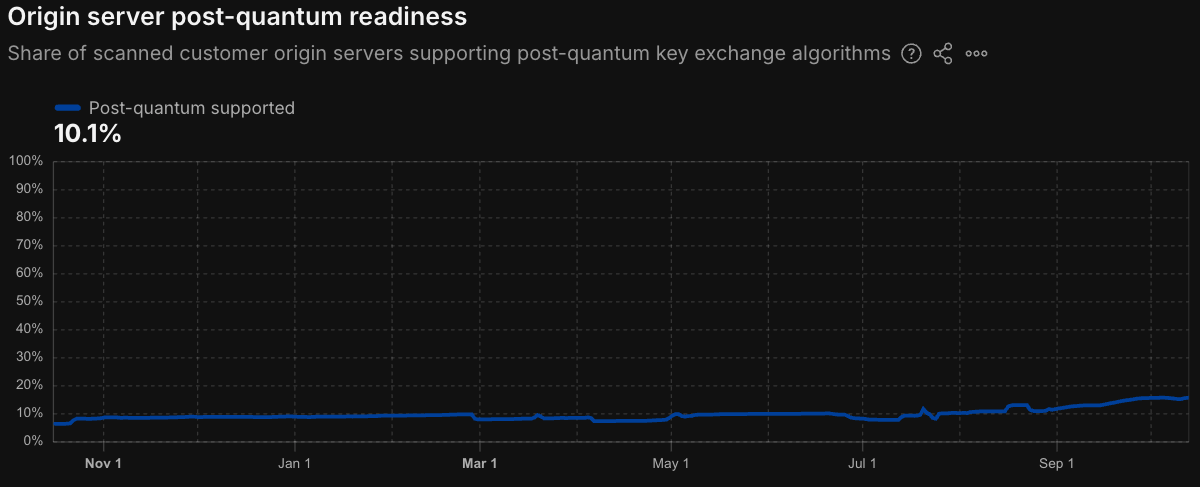 Cloudflare Radar, percentage of origin servers supporting post-quantum key exchange over the past year, around 10% Source, Cloudflare Radar.
How much it costs
Why, then, is it still adopted so little? The recurring objection in a payments platform is latency, since the transport layer is involved. First, two things must be separated. Part of the connections hitting our edge come via resumed sessions. There is no handshake there—the cost is zero, because the session inherits the key from the parent connection. The remainder does negotiate a new key exchange, and that is where we measured the real cost. We ran one thousand handshakes per variant, classical versus hybrid, interleaved, using real authorizations reaching the card network and deliberately targeting the worst-case scenario.
| Metric | Measurement |
| Post-quantum handshake overhead | +4.8 ms per new connection |
| On reused connections | 0 ms, no new handshake |
And for high-volume integrators maintaining persistent connections and routing multiple authorizations through them, the cost is virtually zero: the handshake occurs once per connection, not once per payment.
AI to observe, cloud to move
AI for discovery (surfacing actionable insights in a weekend). We conducted the assessment using AI agents connected in read-only mode to our existing sources (cloud APIs, software and cryptographic inventories, internal service portals, codebase, CDN dashboard, and internal documentation). Proprietary TLS handshakes against dozens of endpoints, reading load balancer policies, cross-referencing inventory against the fifty-six families list. Over a weekend, you get an accurate initial snapshot of where you stand. However, AI cannot replace judgment: every classification was reviewed by a person, and the rigor of distinguishing measured realities from self-declared configurations is what keeps an agent from turning assumptions into findings.The cloud for agility. A cloud-native fintech enjoys a massive advantage over a bank running its own datacenter: many controls are just configuration. Changing the cryptographic policy of managed SFTP is a single parameter. Upgrading the runtime terminating TLS at checkout was a version bump deployed within days. Having a cryptographic inventory as queryable data served as the foundation for governing it.
Vogels reached the same conclusion from another angle. In those same predictions, he wrote that cloud-native organizations will transition smoothly thanks to provider-managed updates, whereas companies relying on self-managed physical infrastructure that fail to plan the migration now will face unfixable vulnerabilities the day quantum computers mature.
Akua, your first step toward Quantum Readiness
A full Quantum Readiness Assessment takes months and touches every player across the value chain. Nobody accomplishes it overnight, nor do they need to. What can be solved right now is the most critical segment: cardholder data in transit across the internet. That is where Akua provides a tangible advantage.
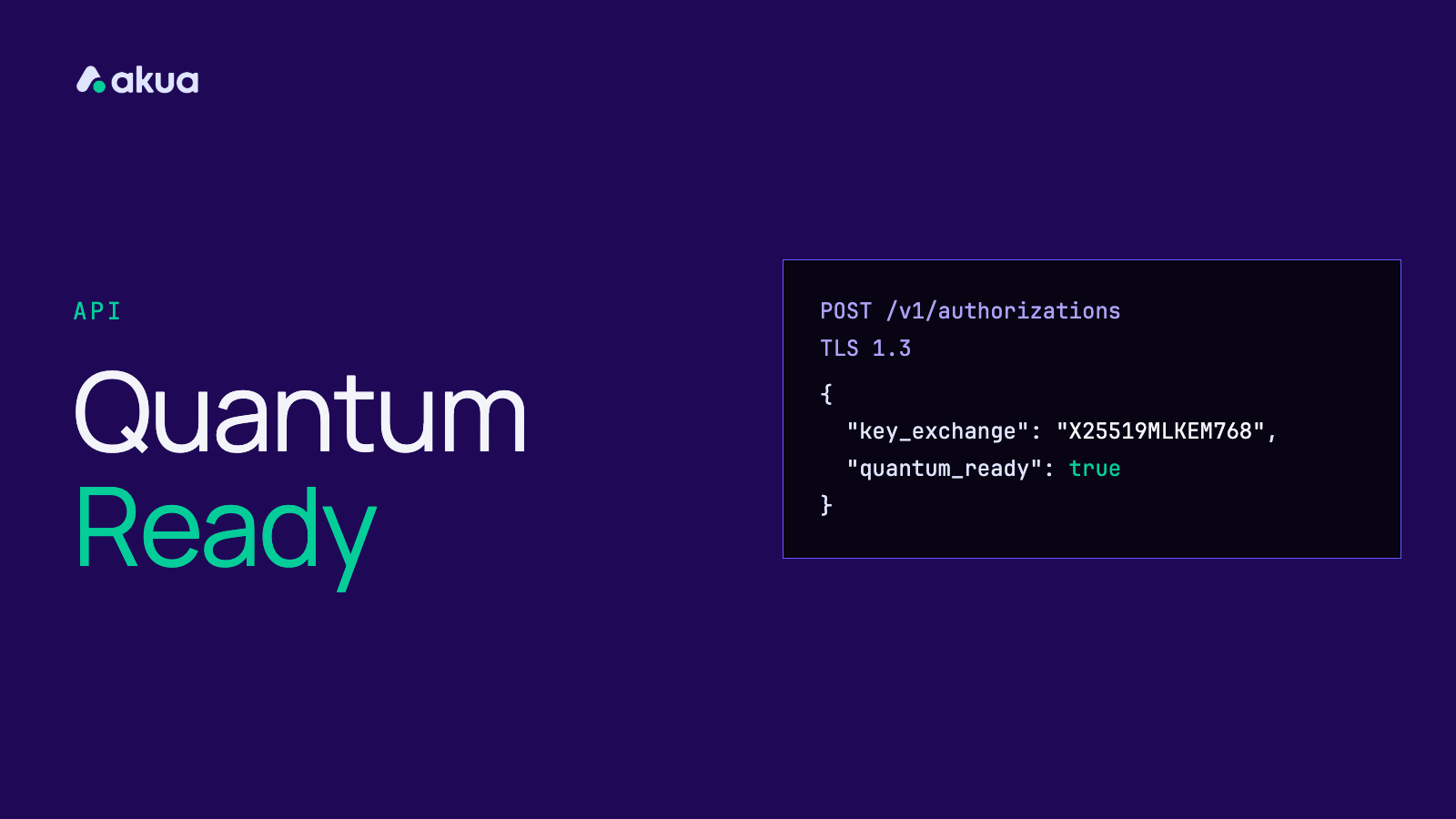
By integrating with Akua's API, you inherit a ready edge. Our public edge offers TLS 1.3 with hybrid post-quantum key exchange. Your part is minimal and well-scoped. To protect your traffic against HNDL, it is enough for the HTTP client
calling us to offer X25519MLKEM768. Across most stacks, this is a simple library or runtime upgrade, not custom development.
You have a partner that has already walked the path. We mapped the inventory, established the methodology, measured the overhead, and know which levers exist and who holds them. That learning directly benefits our clients.
And we continue to support, not demand. Your current integrations will continue to work without modification. Whenever you are ready, you can enable hybrid key exchange, knowing everything on Akua's side is already in place.
Ready to take that first step?
Get in touch with Akua and we'll show you how.