Contactless payments in transit: the challenge is now operational
Passengers are already paying for buses with cards, phones, or watches. Here is what transit operators need to charge for every trip without slowing down the line or losing revenue.
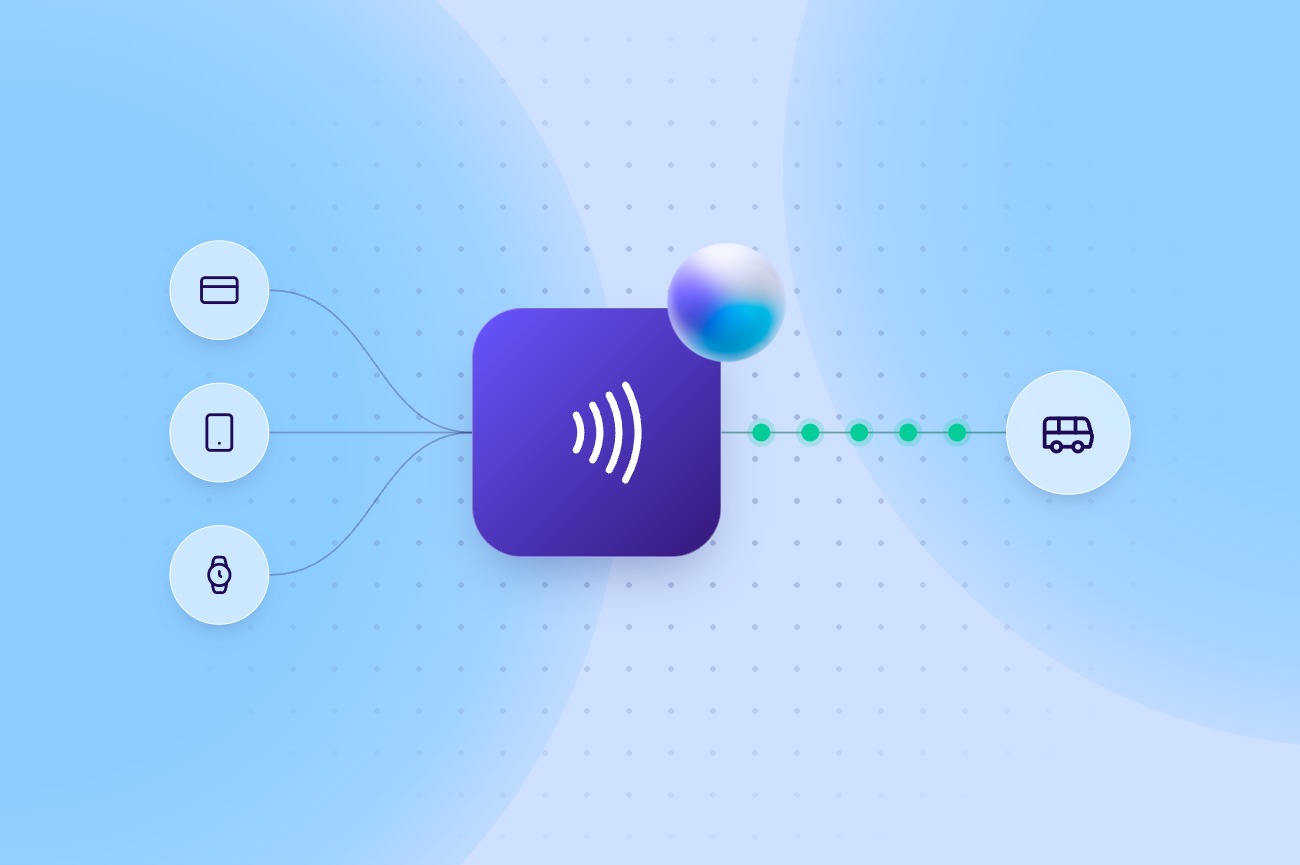
Tapping a card on a bus turnstile is no longer new in Brazil. In São Paulo's intercity buses alone, there were more than 102 million contactless payments through May 2026, according to Autopass. Passengers caught on quickly: there is no need to buy a transit card or top up. They use the debit or credit card, phone, or watch they already have.
The question now is different: can operations keep up? For operators, every tap is a transaction that must be charged in seconds, follow card scheme rules, and get the money into the right account.
What happens behind every turnstile paymentFrom the outside, it is a beep. From the inside, there are at least five problems to solve simultaneously:
Moving lines.
Insufficient funds trips.
Turnstiles without signal.
Fare integration.
Money in the right place.
Each of these points has a solution. The hard part is solving all of them at once, following card scheme rules on every transaction. That is what separates a pilot from an operation that scales.
How Akua solves it: one infrastructure, one integrationAkua acts solely as an acquirer. It is the payment infrastructure between the turnstile and the card schemes. With a single API integration, Akua processes every tap, routes the transaction to card schemes using their transit messaging (MTT), and handles clearing and settlement.
In practice, this means:
- Flat or distance-based fares. Flat fares are charged at tap. Distance or segment-based fares are charged at the end of the trip, with the exact amount.
- Validation without balance checks. Upon tapping, the system checks whether the card is active, not its balance. The passenger passes in seconds and the trip is recorded. Under card scheme rules, the issuing bank is liable for trips with insufficient funds.
- Automatically recovered pending trips. If there are insufficient funds, the trip is recovered on the next tap, along with the new fare, without manual intervention.
- Card, phone, and watch linked to the same account. If the passenger uses another card, their phone, or their watch, the system recognizes the same account and collects pending amounts before granting access.
- Offline operation. The turnstile accepts payment without connectivity and transmits trips as soon as the connection is restored.
- Automatic fare integration. The system identifies the passenger's full journey and applies the integrated fare, even across lines or transport modes.
Who does what: Akua processes, authorizes, collects, issues refunds, recovers pending trips, clears, settles revenue, and monitors terminal certification. The operator remains in control of its own domain: fares, integration rules, benefits, retry schedules, debt blocking, certification of its own terminals, and passenger support.
In practice: the Luup Group case studyLuup Group develops technology for payment management and transit operations in Colombia. With Akua, it stopped relying on a proprietary transit card and began accepting any debit or credit card, from any bank.
Less than 1 month
Over 200 buses
100% of trips
100%
Pablo Villarreal, director at Luup Group, summarizes the shift: "Today I can make real-time decisions based on the information I receive."
Fast to deploy, built to scaleAt Luup, less than a month passed between signing and the first bus collecting fares. This was possible because the infrastructure is already built and requires only a single integration.
And it is not just buses. The same infrastructure supports subways, trains, light rail, cable cars, ferries, bike sharing, and tolls. Every new line or transit mode is added to the same integration and operation, without starting from scratch.
Who it is for:
- Transit operators looking to accept cards, phones, and watches without losing revenue
- Ticketing companies and integrators that need a processing layer designed for transit
- Banks and PSPs looking to process transit payments under their own brand

Luup Group
If you operate transit, ticketing, or payments and want to learn how to bring this to your operations, talk to Akua's sales team.