
Case study
How Luup Group brought card payments to transit with Akua
Luup Group builds technology solutions that simplify payment management and transit operations in Colombia. With Akua, it moved from a closed-loop system to accepting any debit or credit card, using the card networks’ transit messaging (MTT).
< 1 month
From signing to collecting fares on the road
+200
Buses in operation
100%
Trips processed using the card networks’ transit messaging (MTT)
Traceability
Complete visibility into payment operations
The challenge
Bringing card payments to buses without slowing down queues or operations
Bringing card payments to buses meant collecting every fare in seconds, while on the road and complying with all card network rules.
What needed to be solved
- Let passengers travel with any debit or credit card, from any bank.
- Complete payments in seconds, with a fixed fare or a fare based on the journey.
- Prevent a trip with insufficient funds from becoming a loss.
- Meet every card network requirement for each transaction.
- Scale without rebuilding operations, starting with a pilot.
- Gain more control over the payment system to prevent fraud.
- Provide complete, real-time operational traceability.
The solution
Card payments at the validator, using the card networks’ transit messaging (MTT)
With Akua, Luup Group added processing infrastructure designed for transit: a single integration processes every tap at the validator, meets all card network requirements and handles clearing and settlement. This enables Luup Group to scale and grow faster, with the entire platform available.
Card payments at every validator
Any debit or credit card, from any bank, can be used to travel
Known fare, charged at the tap
The fixed fare is charged when the passenger taps
Pay As You Go, charged at the end of the journey
Distance- or segment-based fares, charged at the end of the journey for the exact amount
Card network transit messaging (MTT)
Compliance without technical exceptions from the first trip
Card, phone and watch linked to one account (PAR)
The system recognizes the same account even when the passenger switches between card, phone and watch
Clearing and settlement management
Every collected fare reaches the right recipient, even when it is charged days later
A single API integration
Live and collecting fares in less than a month
The passenger experience
Boarding in seconds, without lost fare revenue
For passengers, paying for the bus became as simple as paying at any store. For the system, every tap is protected until the money reaches its destination.
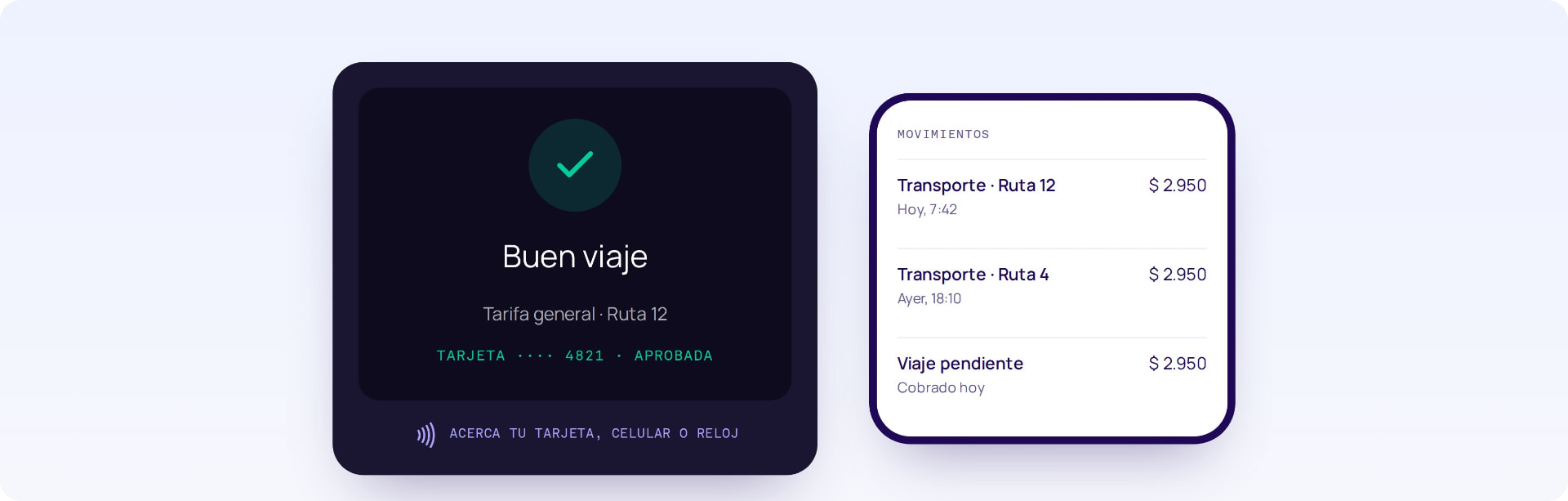
Board in seconds
At the tap, the system checks that the card is active, not its balance, so queues keep moving.
No dedicated transit card
Nothing to buy or top up: passengers use the card, phone or watch they already have.
Validation at the tap without checking the balance
The passenger boards in seconds and the trip is recorded
Outstanding fares collected automatically
The fare is recovered on the next use, along with the new trip, without manual intervention
A new card in the wallet to avoid paying
The system recognizes the same account and collects the outstanding fare before allowing travel
Card network mandate for issuing banks
The passenger’s bank is responsible for trips with insufficient funds and protects the system’s financial health
For mass transit systems
Payments that work offline and transfers handled automatically
In larger transit systems, fare collection must keep working even when a validator loses connectivity. Each trip must also be recognized as part of the same journey so transfer fares are applied without passengers having to do anything.
Offline operations
The validator accepts taps even without a connection and sends the trips as soon as connectivity returns, keeping queues moving and ensuring no trip goes uncollected.
Transfer management
The system identifies each passenger’s complete journey and automatically applies the appropriate transfer fare, even across different routes or modes of transport.
How it works
One trip, five participants and a payment that reaches its destination
Every tap at the validator starts a chain. Here is how the work is shared among the participants who make it possible.
- 01
Passenger
Taps their debit or credit card, phone or watch.
- 02
Validator
The device on the bus or at the station reads the payment and allows boarding in seconds.
- 03
Luup Group
Its technology simplifies system operations and connects information; fares, routes and benefits are defined with the operator.
 04
Akua
Processes the payment, sends it to the card networks with all required information and manages clearing and settlement.
- 05
Card networks and banks
The card networks and the passenger’s bank approve the payment.
 What Akua does
- Processes every transaction and communicates with card networks.
- Authorizes payments, collects fares and issues refunds.
- Securely stores card data.
- Recognizes passengers whether they pay by card, phone or watch.
- Recovers outstanding fares.
- Clears and settles fare revenue.
- Supports terminal certification.
What stays with the operator- Defines fares, transfer rules and benefits.
- Decides when to retry a payment.
- Decides who to block for outstanding debt.
- Supports passengers.
- Certifies its terminals.
For your transit system
The same integration Luup Group uses, for any mode of transport
The infrastructure that processes every tap on Luup Group’s buses is available to any transit company looking to add open-loop payments by card, phone or watch, regardless of its mode of transport, without building a different solution for each one.
For every mode of transport
- Bus
- Metro
- Train
- Tram
- Cable car
- Ferry
- Public bike
- Toll road
Artificial intelligence
With AI agents, operators query and reconcile fare revenue without relying on spreadsheets
Akua is global AI-native financial infrastructure: AI is not a separate module, it is part of every layer of operations. These are platform capabilities; which ones Luup Group uses today remains to be confirmed with the Product team.
Operations agent
How many trips were left unpaid yesterday?
Yesterday, 312 trips were left unpaid. Today, 287 have already been recovered and will settle at the next close.
Reporting agent
Create a report of the last 25 trips on Line 12, between 9:00 and 17:00.
Done. Here are the last 25 trips on Line 12 between 9:00 and 17:00:
25
Trips
24
Approved
1
Outstanding
$ 70.800
Fare revenue
Report_line12_9to17.csv
Illustrative example
Operations agents
Approval and fraud intelligence
Agents for operators
Support and voice
MCP / connected data
Adding trips and lines does not require growing the operations team at the same pace.
Pablo Villarreal, Director of Luup Group, shares firsthand the challenges they faced and how they solved them.
The difference
Akua’s technical and strategic advantages
- Cloud-native infrastructure, without legacy terminal systems
- Card network transit messaging (MTT), without technical exceptions
- Offline operations, so fare collection continues even when the validator loses connectivity
- Automatic transfer management, identifying each passenger’s complete journey
- PAR on every payment to link the card, phone and watch to the same account
- Clearing and settlement on the same platform
- AI-native: agents in operations, fraud and support
- PCI certification


Pablo Villarreal
Director of Luup Group
Complete payment traceability
“Today I can make decisions in real time based on the information they provide. Before, I had to wait for the reconciliation process and go through additional processes to access information.”
< 1 month
From signing to collecting fares on the road
+200
Buses in operation
100%
Trips processed using the card networks’ transit messaging (MTT)
Traceability
Complete visibility into payment operations